Yidu Tech Unveils "Clinical Copilot for Doctors", Serving as an Intelligent Assistant Within Physicians' Workstations
2025-10-15
As AI in healthcare enters the "deep water zone of implementation," how can large language models (LLMs) truly understand clinical practice, integrate into workflows, and aid decision-making?
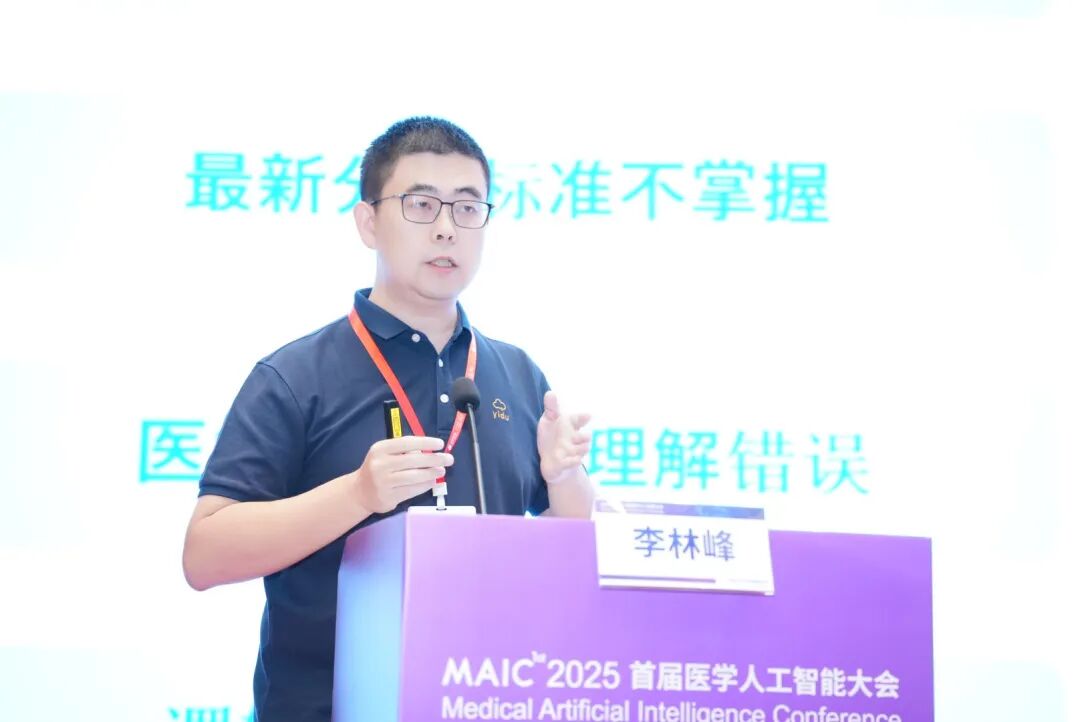
At the inaugural Medical Artificial Intelligence Conference (MAIC 2025), Li Linfeng, Vice President of Technology Innovation and AI Architect at Yidu Tech, delivered a keynote speech, systematically introducing the company's "Clinical Copilot for Doctors." This product suite is based on a dual-engine architecture of "Data Middle Platform + AI Middle Platform." It is dedicated to deeply integrating LLM technology with clinical workflows, enabling the "seamless" application of AI across the entire spectrum of diagnosis and treatment, comprehensively empowering physicians to improve quality and efficiency, and assisting hospitals in efficiently completing their digital-intelligent transformation.
1. Dual Middle Platforms Address Pain Points in AI Healthcare Implementation, Deployed in Over 30 Hospitals
Li Linfeng pointed out that during the application of LLMs, the demands from various hospital stakeholders are clear and urgent: Hospital administrators focus on top-level design to drive high-quality hospital development with AI; clinicians expect AI to become an assistant that enhances efficiency, expands professional knowledge, and integrates with personal diagnostic thinking; while the IT departments urgently need to ensure the rapid, secure, and unified deployment and management of LLMs to efficiently respond to the needs of various departments.
Confronting the three major pain points in hospital AI implementation—"difficult data integration, challenging model management, and poor scenario adaptation"—Yidu Tech has built a dual-middle-platform solution comprising "Data Middle Platform + AI Middle Platform":
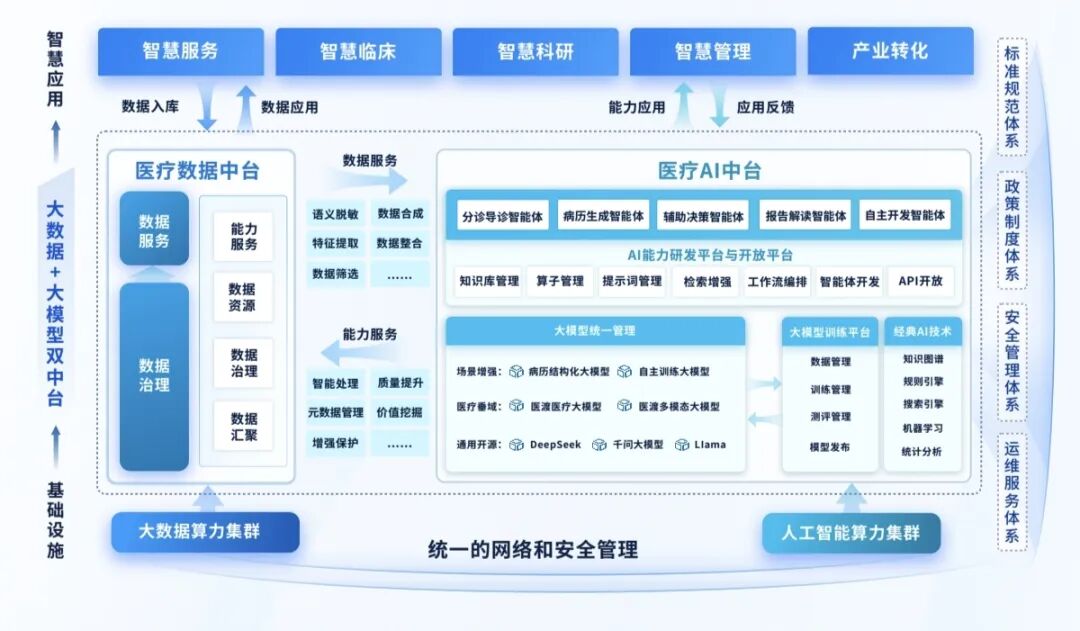
- Data Middle Platform: Leveraging over a decade of Yidu Tech's data governance experience, it helps hospitals integrate multi-source, heterogeneous data, building dedicated data warehouses for clinical, research, and operational purposes, becoming the "data circulatory system" for hospital transformation.
- AI Middle Platform: As the core innovation module, it is powered by a dual-engine of "Knowledge + Tools." On one hand, it supports the unified management, training, and evaluation of multiple LLMs and provides "no-code intelligent agent creation" capabilities—clinicians can build their own AI tools in just three steps: "select model, upload knowledge base, configure workflow," with no coding required. On the other hand, the platform comes pre-loaded with authoritative medical content, covering 1,000+ clinical guidelines, a knowledge graph of 100,000+ medical entities, and 40+ medical AI operators. It features specialized optimizations for charts and formulas within clinical guidelines, addressing the pain point of "difficult knowledge parsing."
Currently, this dual-middle-platform solution has been deployed in over 30 renowned tertiary hospitals across China. The First Affiliated Hospital of Chongqing Medical University built a General Practice Intelligent Assistant based on guidelines, literature, and internal protocols, significantly enhancing the cross-specialty diagnosis and treatment capabilities of its affiliated primary care hospitals. The Children's Medical Center affiliated with Capital Medical University quickly integrated knowledge bases via the AI Middle Platform to create an AI-powered customer service system for handling patient inquiries upon receipt, enabling 7×24-hour, full-process patient consultation and science education services.
2. Clinical Copilot for Doctors: 25 Scenario-Specific Intelligent Agents Meticulously Developed
If the AI Middle Platform is the "toolbox" for hospital AI applications, then the "Clinical Copilot for Doctors" is the intelligent assistant residing "within the physician's workstation."
Li Linfeng explained that the design of the "Clinical Copilot for Doctors" centers on "seamless integration, intelligent support, and comprehensive coverage." Through a lightweight web plugin, it seamlessly embeds into physician workstations, enabling automatic access to patient data and flexible scenario-based filtering, making the AI assistant readily accessible. It is powered by multiple engines working in synergy: for instance, the DeepSeek reasoning model is suitable for complex clinical inference, while Yidu Tech's self-developed domain-specific LLM offers higher accuracy and professionalism, excelling in medical record comprehension and summarization, and can flexibly connect to various knowledge bases and tools.
Currently, Yidu Tech has completed the meticulous development of 25 scenario-specific intelligent agents, achieving full-process empowerment from intelligent medical record generation, AI-assisted pre-consultation, and evidence-based decision support to patient education and smart nursing care. It also supports physicians in customizing personalized assistants, realizing "All in One" intelligent assistance.
- Medical Record Generation Agent: Integrates voice consultation notes, hospital history, and pre-consultation data, employing dual constraints of "knowledge + facts" to address issues of model hallucination and non-standard formatting.
- TNM Staging Agent: Through a workflow of "tumor type determination + RAG (Retrieval-Augmented Generation) technology + chain-of-thought reasoning + intelligent reflection," it improved the accuracy of T staging from 58% to 90% and N staging from 62% to 80% (reaching the level of a chief physician), enhancing the professionalism and interpretability of TNM staging assessments and reducing misjudgments.
- Evidence-Based Treatment Recommendation Agent: Based on multi-source guidelines and literature, it implements a workflow of "extract patient data → summarize key conditions → retrieve relevant guidelines → rank guidelines → recommend single-source treatment plans (with traceability support) → summarize multi-source conclusions," preventing evidence fabrication and aligning with physician decision-making habits.
- Patient Education Closed Loop: Upon admission, AI automatically generates treatment plan interpretations based on the patient's condition. Before discharge, it automatically generates discharge instructions. After physician confirmation, these can be sent to patients with one click, providing patients with immediate, clear, and traceable health guidance throughout their journey.
- Customizable Intelligent Assistant: Empowers physicians with AI design rights. Based on a unified LLM foundation, physicians can select patient data, configure business process logic according to their personal diagnostic experience and habits, and build their own intelligent agents with zero code, addressing the pain point where standardized tools often fail to meet the diverse needs of individual doctors.
3. Oncology Diagnosis and Treatment Practice: From "Tool Empowerment" to "Business Endogeneity"
"Oncology is a relatively complex disease. In the process of oncology diagnosis and treatment, it is necessary to review all the patient's past treatments, from the initial situation to the tumor's evolution process, and also examine imaging, lab tests, biochemical indicators, etc. Doctors need to comprehensively understand the patient in a very short time, which presents certain difficulties. Simultaneously, oncology diagnosis and treatment must follow clinical guidelines and undergo strict quality control." Li Chaofeng, Director of the Information Center at Sun Yat-sen University Cancer Center (SYSUCC), previously highlighted the core challenges of oncology diagnosis and treatment and the practical necessity of applying AI technology in a media interview, stating, "AI holds great promise in enhancing the efficiency and standardization of diagnosis and treatment."
At this MAIC 2025 conference, Director Li Chaofeng delivered a keynote speech titled "Practices of Large Models Promoting High-Quality Hospital Development," sharing in-depth results of the collaboration with Yidu Tech. He pointed out that based on nearly a decade of foundational cooperation on data platforms, the two parties have further joined hands to be the first to integrate the hospital's "Data Middle Platform" and "AI Middle Platform," achieving unified management and scheduling of data, algorithms, and computing power, thus constructing a solid foundation for the hospital's intelligent evolution.
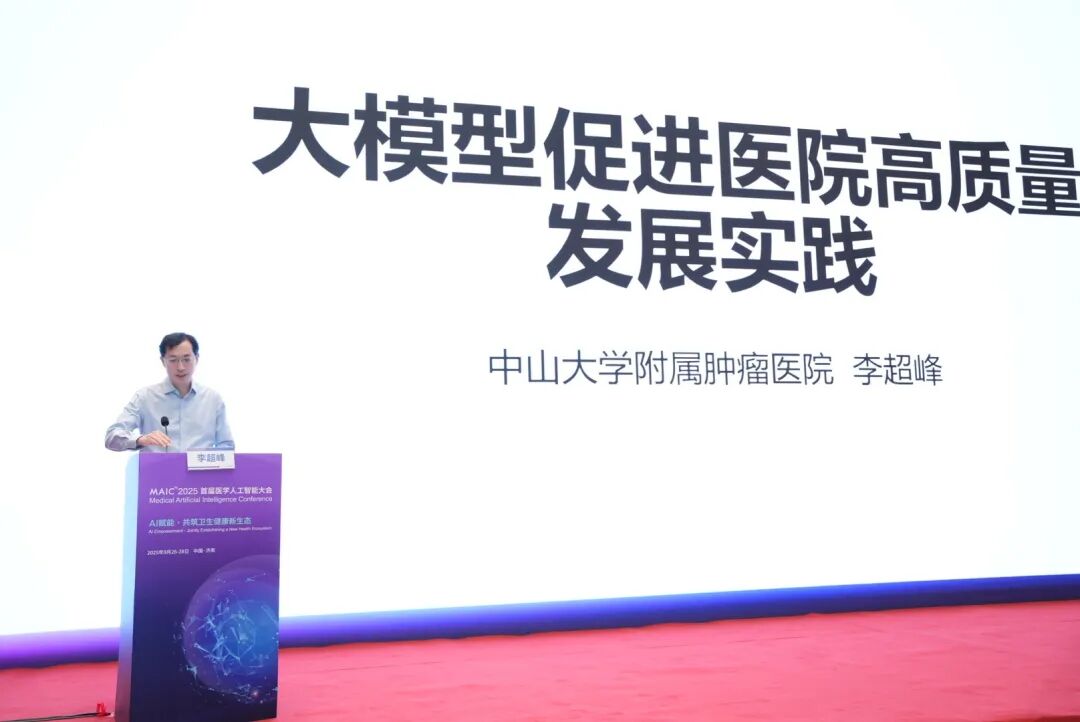
Director Li Chaofeng highlighted two key pathways in practice: First, empowering individuals by creating "a thousand personalized intelligent agents": Currently, hospital medical staff have independently created over 140 personalized intelligent assistants, applied in diverse scenarios such as condition summarization, preoperative risk assessment, and postoperative order verification, greatly meeting the personalized needs of different roles. Second, deeply integrating into workflows to create "process-embedded intelligent agents": By deeply embedding AI capabilities into core diagnosis and treatment processes, the issue of AI tools and clinical workflows operating in "separate silos" is effectively avoided, genuinely enhancing physician work efficiency.
The implementation of Yidu Tech's dual-middle-platform at SYSUCC has yielded systematic, significant results, releasing breakthrough value across three core dimensions: clinical diagnosis/treatment, scientific research, and IT construction efficiency. The Clinical Copilot for Doctors has also achieved rapid implementation and effectiveness—from February to June 2025, in just four months, it has assisted doctors in serving over 26,000 patient visits cumulatively.
Li Linfeng stated that through the dual-middle-platform and Clinical Copilot for Doctors product suite, Yidu Tech achieves unified management of data and AI elements, ultimately delivering value to hospitals such as "accelerated data flow, faster research translation, reduced burden on medical staff, refined management, and intelligent services." He expressed: "We hope that AI is no longer just an add-on tool but becomes an endogenous force for hospitals' high-quality development, ultimately making precision medicine accessible to everyone."
本文为原创内容,仅供知识分享之目的,若存在侵权行为或疏漏,请与本平台联系,我们将及时处理。如需转载请后台留言,需征得本平台同意且注明来源转载。